Mark Zuckerberg just fired his biggest shot in the AI war. After spending billions, rebuilding his entire AI team from scratch, and hiring one of Silicon Valley’s most sought-after executives — Meta’s Muse Spark is finally here.
Meta · Muse Spark · Superintelligence Labs
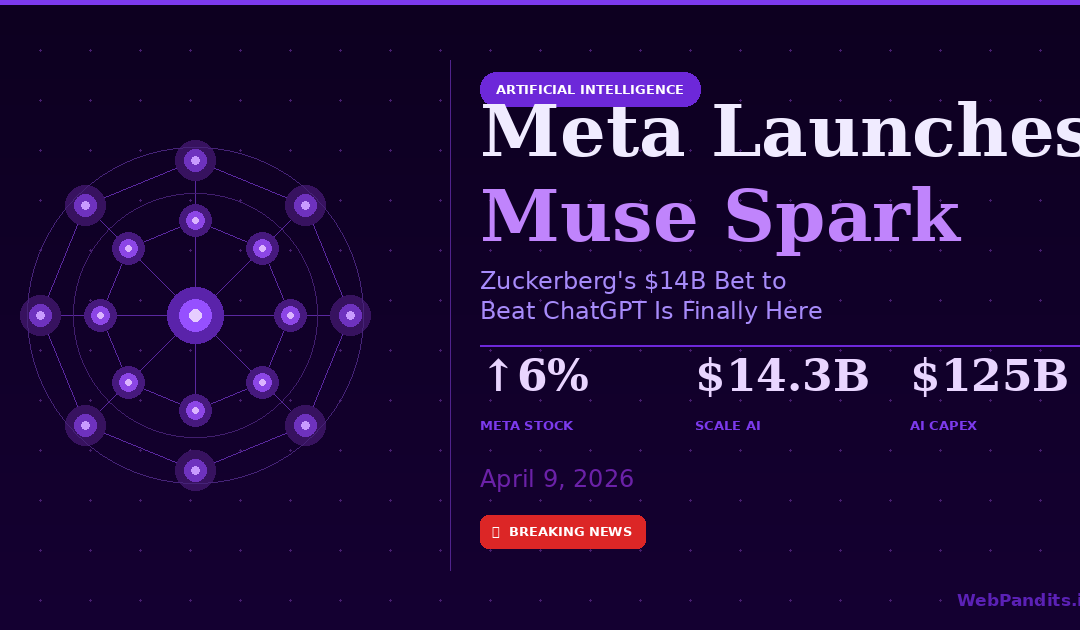
Meta’s Muse Spark is the first model from Meta Superintelligence Labs, led by Chief AI Officer Alexandr Wang. | Illustration: WebPandits
Meta just launched its most powerful AI model to date — and for the first time in years, the company that built Facebook, Instagram, and WhatsApp looks like it might actually be back in the AI race. On Wednesday, April 8, 2026, Meta unveiled Muse Spark, a brand-new large language model built from scratch by its newly formed Meta Superintelligence Labs. The launch sent Meta’s stock surging more than 6% and marked the company’s most significant AI moment since it first released its open-source Llama models.
But this time, everything about Meta’s AI strategy has changed — the team, the model, the philosophy, and even the approach to open-source. This is not an incremental update. It is, as Meta itself calls it, a “ground-up overhaul.”
⚡ Key Facts at a Glance
▸ Muse Spark is the first model from Meta Superintelligence Labs, led by Alexandr Wang
▸ Built over 9 months with a completely rebuilt AI stack from the ground up
▸ Now live on Meta AI app and meta.ai — rolling out to WhatsApp, Instagram, Facebook, Messenger & Ray-Ban glasses soon
▸ Accepts voice, text and image inputs — outputs text only
▸ Closed model — a major U-turn from Meta’s previous open-source Llama strategy
▸ Free to use for consumers; API access in private preview for select partners
▸ Competitive with OpenAI, Google & Anthropic on multimodal and health tasks — coding gap acknowledged
▸ Meta’s 2026 AI capex: $115B–$135B — nearly double last year
What Is Muse Spark?
Muse Spark is Meta’s most powerful AI model to date and the first in what the company calls its new “Muse series” — a deliberate, generation-by-generation approach to model scaling. It is purpose-built for Meta’s products and will power a smarter, faster Meta AI, eventually unlocking new features that cite recommendations and content people share across Instagram, Facebook, and Threads.
Dubbed Muse Spark and originally code-named “Avocado,” the model is the first from Meta Superintelligence Labs — the AI unit led by Chief AI Officer Alexandr Wang. Wang joined Meta in June as part of the company’s $14.3 billion investment in Scale AI, where he was CEO.
Over the last nine months, Meta Superintelligence Labs rebuilt its AI stack from the ground up, moving faster than any development cycle the company had run before. Muse Spark is the first model in the new Muse series — small and fast by design, yet capable enough to reason through complex questions in science, math, and health.
“We are on our way to personal superintelligence: an assistant that can help anyone, anywhere with the things that matter most to them.”
— Meta, Official Blog Post, April 8, 2026Where Will You Use It?
Muse Spark currently powers the Meta AI assistant in the standalone Meta AI app and desktop website. It will debut in the coming weeks inside Facebook, Instagram, WhatsApp, and Messenger, as well as in the company’s Ray-Ban Meta AI glasses. That means billions of users across Meta’s ecosystem will interact with this model — whether they know it or not.
The model works in multiple modes depending on the task. Users can tap one mode for quick answers to simple questions, and another for more complicated queries — such as analyzing legal documents or gleaning nutritional information from photos of grocery store products. A more advanced “Contemplating” mode is rolling out gradually for the most complex tasks.
Parallel Agents: A Smarter Way to Think
For its Contemplating mode, Muse Spark uses a squad of AI agents to “reason in parallel,” helping it compete with the extreme reasoning modes of frontier models such as Gemini Deep Think and GPT Pro. Meta’s own example: planning a family trip where one agent drafts the itinerary, another compares destinations, and a third finds activities — all simultaneously, delivering a better answer faster.
The Big U-Turn: Closed, Not Open-Source
Perhaps the most strategically significant aspect of Muse Spark is what it is not: open-source. In a pivot from the company’s prior open-source strategy, Muse Spark is a closed model, meaning its design and code won’t be made public. This is a dramatic reversal for a company that built its AI reputation on freely sharing its Llama models with the world.
Unlike Meta’s previous AI models, which were released as “open weight” models — meaning anyone could download, modify, and fine-tune them — Muse Spark is primarily an in-house tool for Meta, making it even more proprietary than the paid models offered by Meta’s rivals. Meta has said it hopes to open-source future versions of the model.
⚠️ Privacy Watch
Muse Spark users need to log in with an existing Meta account such as Facebook or Instagram. Meta doesn’t explicitly say that personal information will be used by the AI — but it is likely, given that Meta generally trains on public user data. If you use Muse Spark, assume Meta is learning from the conversation.
How Does It Compare to ChatGPT and Claude?
A Meta executive told Axios that Muse Spark doesn’t mark a new state of the art, but is competitive with the latest models from leading labs at certain tasks — including multimodal understanding and processing health information. In other areas, including coding, the company acknowledges that there is a gap between Muse Spark and models already available.
According to benchmark tests that Meta published, the model is competitive with leading AI models from OpenAI, Anthropic, and Google across many tasks, although it does not surpass them across the board. Still, if the benchmark results hold up when tested by independent experts, Muse Spark seems to put Meta back in the AI race after its last AI model, Llama 4, which was released in April 2025, was widely panned as a dud.
Shopping Mode: Meta’s Secret Weapon?
A “shopping mode” highlights how Meta hopes to differentiate itself — it combines large language models with data on user interests and behavior. Meta also plans for Muse Spark to eventually power the company’s Vibes AI video feature in the Meta AI app. Combined with Meta’s unparalleled social graph of over 3 billion users, this could be the feature that makes Muse Spark genuinely dangerous for rivals.
The Team Behind Muse Spark
Muse Spark is the inaugural model to come out of Meta Superintelligence Labs, which was created last year because CEO Mark Zuckerberg was reportedly unhappy with the progress of Meta’s Llama models and how they lagged behind OpenAI’s ChatGPT and Anthropic’s Claude. Meta recruited former Scale AI co-founder and CEO Alexandr Wang to lead Meta Superintelligence Labs and invested $14.3 billion in the data labeling company for a 49% stake.
Aside from its investment in Scale AI and hiring of Wang, Zuckerberg’s company has recruited researchers from OpenAI, Anthropic, and Google. Meta has assembled, in effect, an all-star AI team built from the talent that built the very models it is now trying to beat.
The Money Behind the Mission
Meta is ramping up its spending on AI infrastructure aggressively. In its latest earnings report, Meta said its AI-related capital expenditures in 2026 will be between $115 billion and $135 billion — nearly twice its capex last year. This is an extraordinary level of investment for a single company in a single year, and it explains why Zuckerberg is betting everything on Muse Spark delivering results.
📈 Market Reaction · April 8, 2026
What This Means for India & You
For India’s 500+ million social media users — most of whom use WhatsApp and Instagram daily — Muse Spark is about to become a constant background presence in their digital lives. Unlike ChatGPT or Claude, which require users to actively open a separate app, Muse Spark will be baked directly into apps Indians already use every single day.
This makes Meta’s AI play fundamentally different from its rivals. It is not asking users to change their behaviour — it is embedding intelligence into habits that already exist. For Indian businesses using WhatsApp for customer service, Instagram for commerce, and Facebook for advertising, this integration could reshape how they interact with AI entirely.
Bottom Line
Muse Spark is not yet the best AI model in the world — Meta freely admits that. But it does not need to be. What Meta has that no other AI company has is distribution at planetary scale: 3+ billion users, five of the world’s most-used apps, and now a proprietary AI model woven through all of them. If Muse Spark is even half as capable as its rivals claim, the combination of reach and intelligence could be devastating for the competition.
Zuckerberg spent years and billions getting to this moment. The question now is whether Muse Spark can deliver — or whether, like Llama 4, it will disappoint. The answer will define Meta’s next decade.
“Over the last nine months, Meta Superintelligence Labs rebuilt our AI stack from the ground up, moving faster than any development cycle we have run before. This initial model is small and fast by design, yet capable enough to reason through complex questions in science, math, and health.”
— Meta, Official Blog Post, April 8, 2026